MI Pages
Managed Intelligence (MI) Pages are the analyst-facing layer of the Orion platform. They are designed for analysts, investigators, and operational teams who need continuity, not volume. MI Pages preserve events as persistent records, expose change over time, and support the creation of finished intelligence products without collapsing evidence or context.
For organizations that require control over data prior to ingestion (including source selection, ingestion behavior, and operational configuration), MI Pages are deployed on the underlying Orion SaaS platform (Tier 5).
MI Console: Pattern Intelligence
The MI Console is the analytical discovery surface. It transforms how analysts and investigators interact with information by eliminating the need to rebuild context daily. Events are preserved as persistent records that evolve as new reporting emerges from any configured source.
What the Console Does
Most analytical friction comes from repetition. The same events are re-read, re-summarized, and re-contextualized because the system itself does not remember.
The MI Console solves that problem. Each event is a persistent analytical record. Reporting from multiple sources — external feeds, internal systems, field reports, or structured data — is attached over time, not rewritten or replaced. Earlier understanding remains visible. Change is explicit. Confidence is tracked as state, not implied by recency.
Inputs are data. The MI Page is the product.
Core Capabilities
- Pattern Arcs – Visualize event evolution over time, seeing progression, escalation, or stabilization
- Topic Velocity – Identify acceleration or cooling in reporting momentum
- Heating & Cooling Views – Rapidly triage emerging vs. declining issues
- Narrative Tracking – Detect how framing and interpretation shift across sources
- Source Distribution – Assess reporting breadth and corroboration across input types
- Context-Preserved Sharing – Send complete patterns or SITREPs with full lineage intact
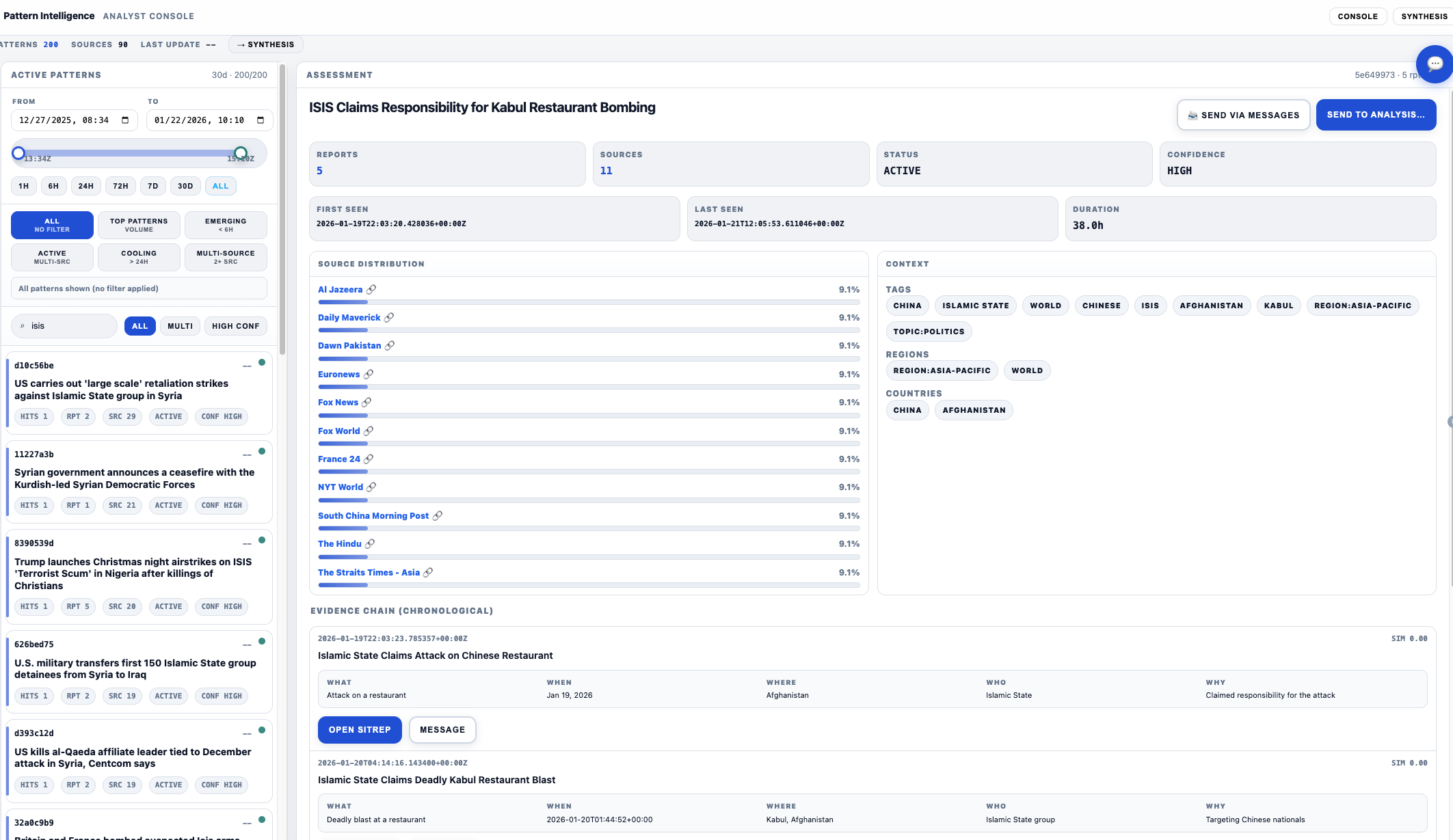
The MI Console showing pattern arcs, velocity indicators, and multi-source event tracking with preserved chronological context.
Synthesis Workbench: Intelligence Production
The Synthesis Workbench is where analysis becomes durable intelligence. Analysts and investigators transform discovered patterns into finished products with frozen evidence, preserved lineage, and clear separation between observation and judgment.
What Synthesis Adds
Preserving events is only the first step. Intelligence work begins when evidence is selected, judgments are formed, and conclusions are communicated.
The Synthesis Workbench allows analysts to curate evidence from MI Pages and freeze it at the time of attachment. This prevents retroactive drift and ensures judgments are anchored to the information that existed when the assessment was made.
Analyst judgment is separated from evidence.
Notes, assessments, and relationships are authored by humans. The system does not infer conclusions, speculate, or rewrite sources. Products move through clear states — draft, final, shared — and can be exported for briefing without breaking source lineage.
Production Capabilities
- Evidence Freezing – Lock context at the moment of assessment to prevent retroactive drift
- Event Curation – Assemble SITREPs into structured products reflecting analytical relevance
- Judgment Recording – Author conclusions directly alongside supporting evidence with explicit linkage
- Living Products – Update assessments as situations develop while retaining historical context
- Version Governance – Snapshot every revision, enable controlled rollback, and preserve a complete audit trail of analytic evolution
- Reference-Based Sharing – Grant access to single authoritative products (not copies) for collaboration
- Export Workflows – Generate briefing-ready outputs without reformatting or losing lineage
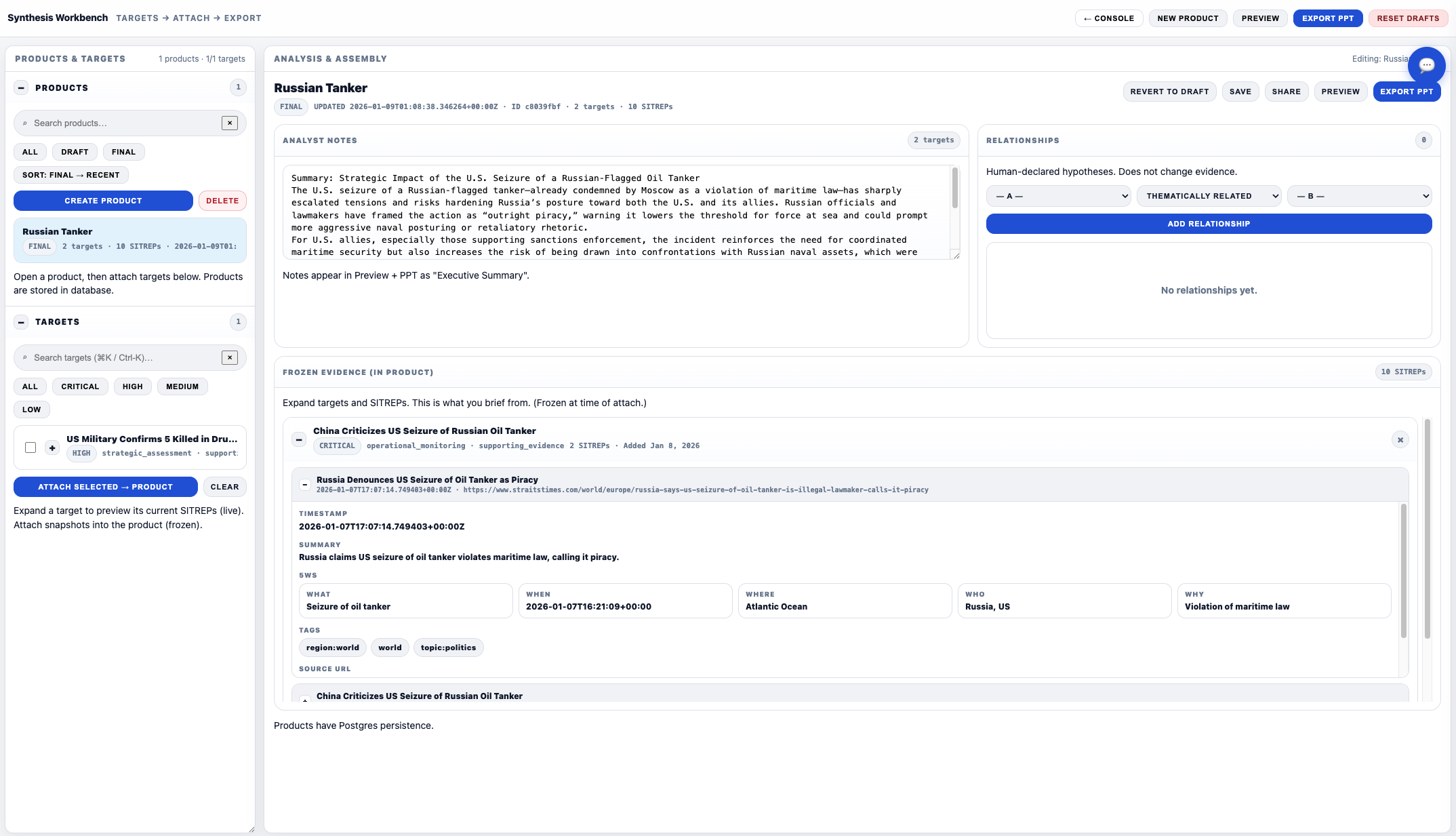
The Synthesis Workbench showing analyst-authored assessments, frozen evidence, preserved source lineage, and collaborative product development.
Geospatial Intelligence Module: Spatial Acceleration
The Geospatial Intelligence Module introduces a spatial analytical surface to MI Pages. Patterns are no longer viewed only through time and narrative progression, but through geographic concentration, dispersion, and regional escalation.
What Spatial Intelligence Adds
Complex situations are rarely confined to a single location. Distributed reporting across regions can obscure escalation signals that are visible only when viewed spatially.
The Geospatial Module accelerates cognition by compressing multi-source, multi-location reporting into a unified operational surface. Analysts and investigators can rapidly identify clustering, detect geographic acceleration, and distinguish localized events from broader regional patterns.
Time reveals evolution. Space reveals concentration.
Geospatial Capabilities
- Spatial Pattern Clustering – Visualize event concentration across regions and jurisdictions
- Geographic Signal Density – Identify hotspots and distributed activity
- Regional Escalation Detection – Surface emerging geographic acceleration
- Area-of-Interest Filtering – Focus on operationally relevant regions, districts, or zones
- Cross-Pattern Co-Location Analysis – Detect overlapping geographic signals across event types
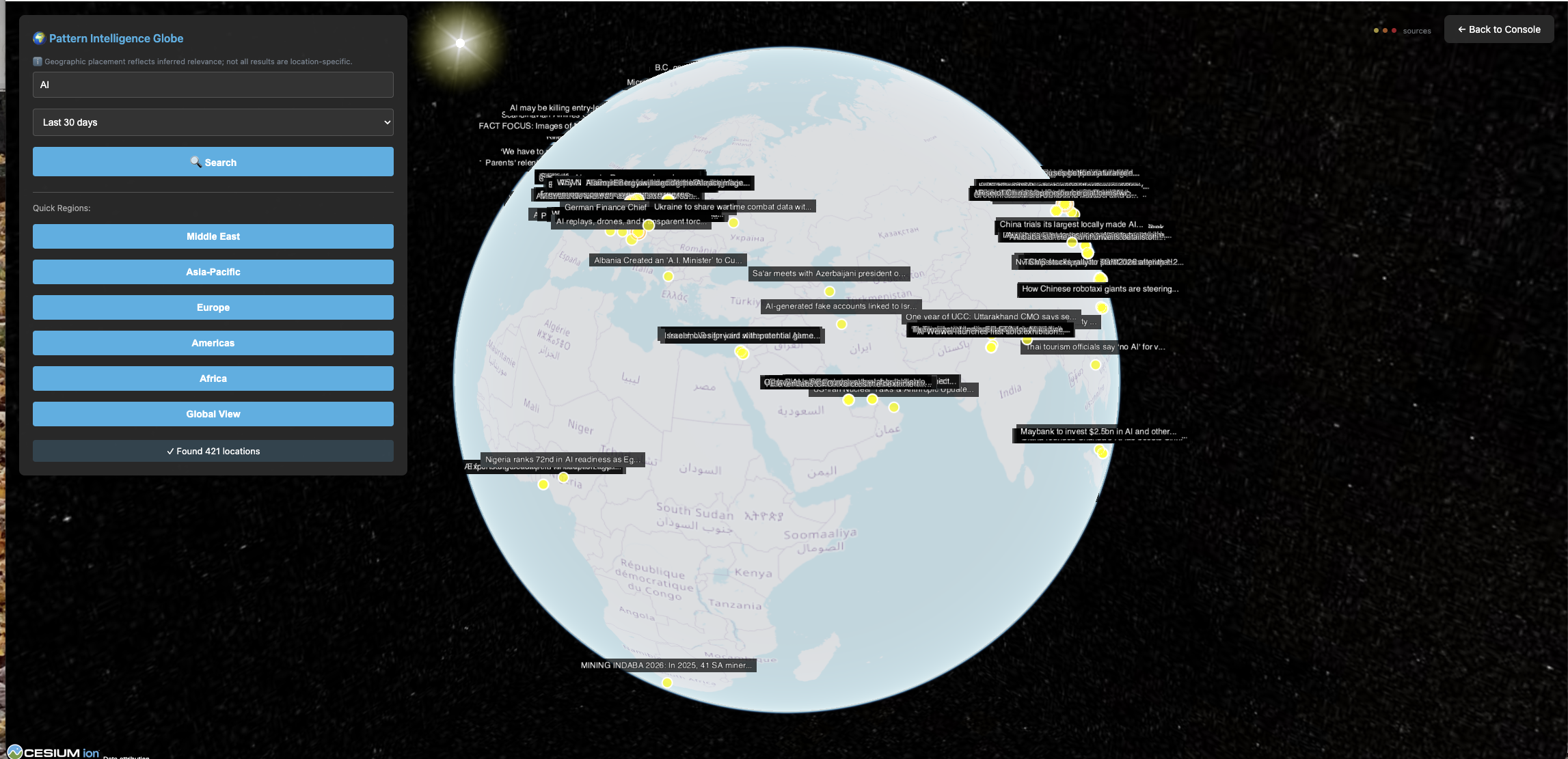
Global operational surface displaying distributed pattern activity and spatial signal concentration across regions.
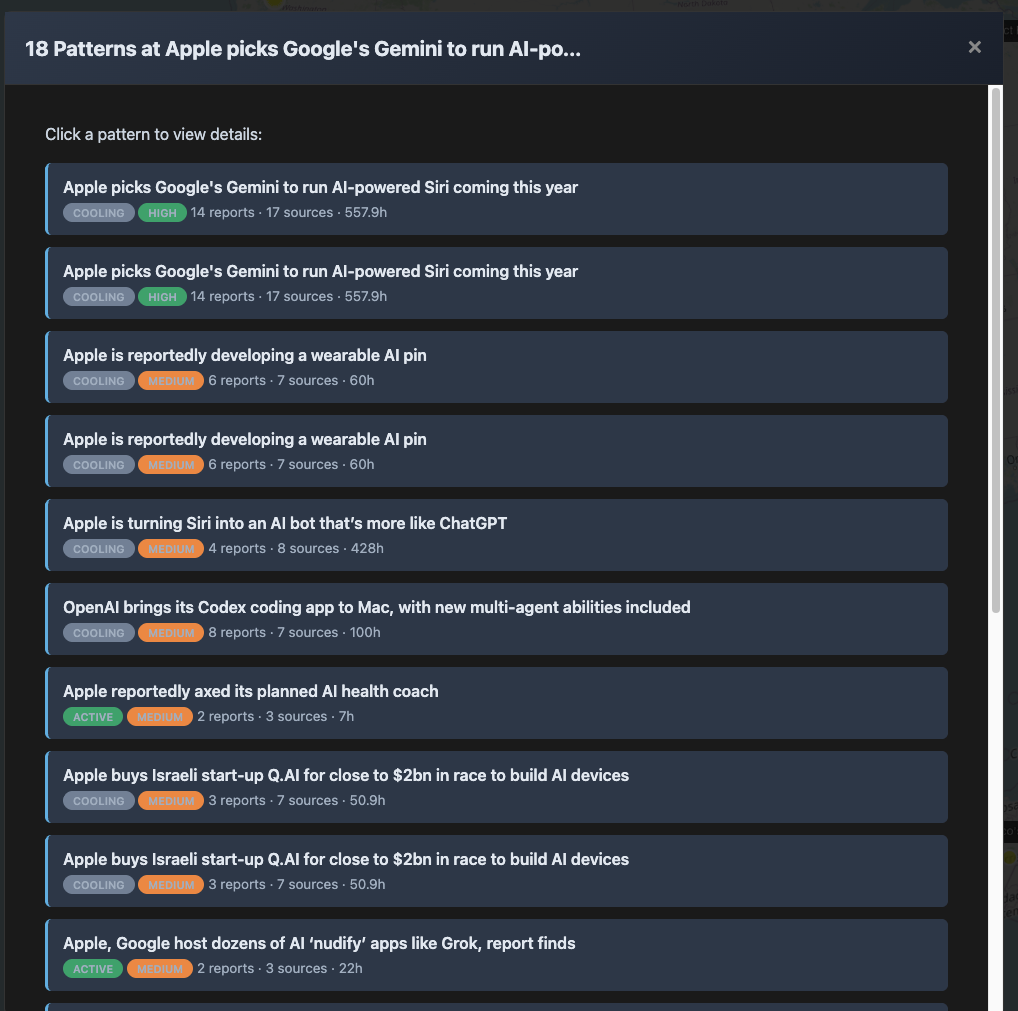
Regional clustering view highlighting geographic density and cross-pattern concentration signals.
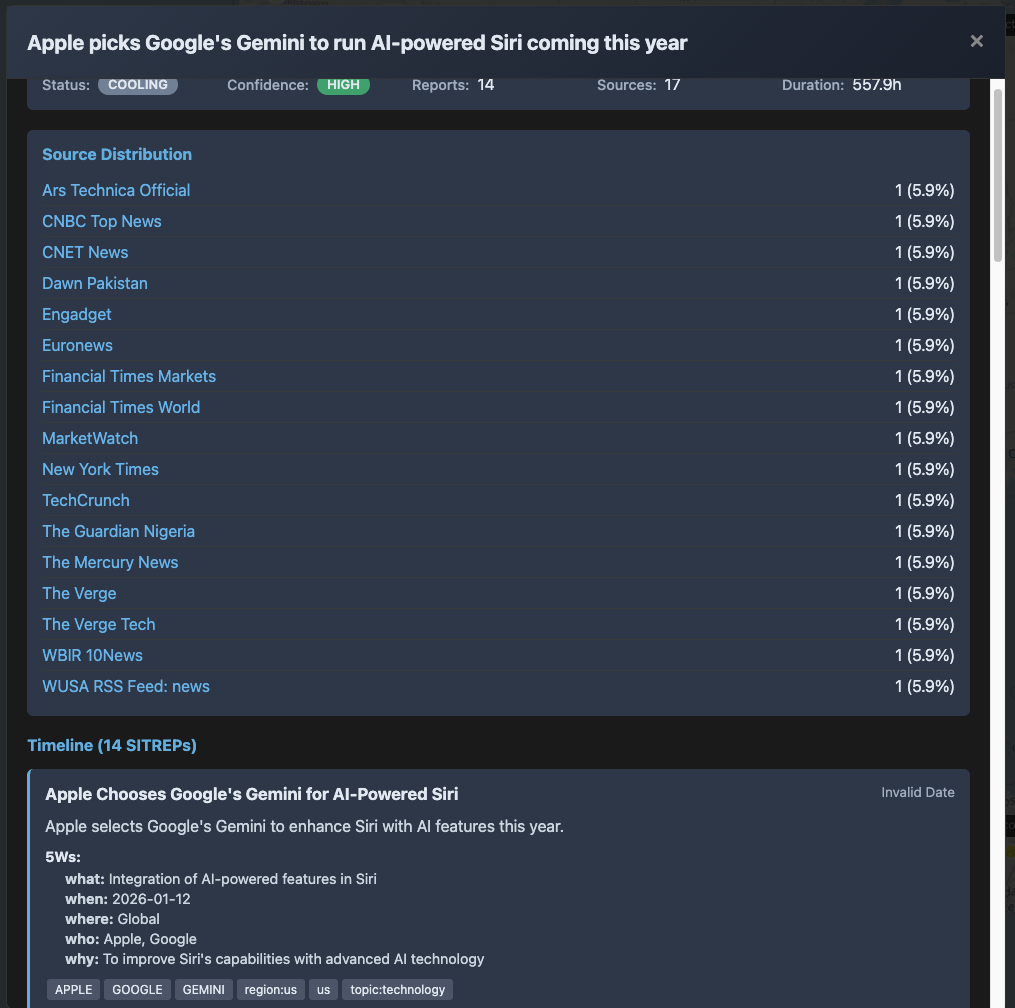
Spatial-to-evidence drill-down view linking geographic signals directly to underlying SITREPs and preserved source context.
Available as Tier 4 — Synthesis + GEO, bundled with the Synthesis Workbench.
Why This Model Matters
Traditional monitoring systems optimize for speed and volume. MI Pages optimize for continuity and responsibility.
Tier 3 (Console) eliminates the burden of context reconstruction. Analysts and investigators see what changed without re-reading what stayed the same.
Tier 4 (Synthesis) transforms ephemeral analysis into durable intelligence. Products are evidence-backed, version-controlled, and exportable without breaking lineage.
By preserving events and separating evidence from judgment, teams spend less time reconstructing context and more time doing actual analysis.
The result is not more information — it is more durable understanding.
Relationship to the Consumer Experience
The consumer BriefBrief experience (Free Trial through Tier 2) is built on the same Orion event-based foundation.
Consumer briefs present the current state of events in a concise, readable format. MI Pages expose the full depth of those same events for analytical and investigative use.
The structure is shared. The depth is not.
Tier 1–2 users see consolidated SITREPs. Tier 3 analysts and investigators see pattern arcs, velocity indicators, and source distributions. Tier 4 users build finished products from that same foundation.
Every access level operates on the same persistent event model — only the analytical surfaces change.
Get Started
MI Pages are available by self-service subscription. All professional tiers include Consumer Premium (Tier 2), mobile applications, XMPP secure messaging, SITREP sharing, pattern intelligence search, historical pattern archive, PowerPoint export, and MFA-protected access.
Professional platforms require a desktop browser — not available in the mobile app.
Brief Technologies LLC is a Service-Disabled Veteran-Owned Small Business (SDVOSB). CMMC Level 2 Self-Assessment Complete · SPRS Score on File · CAGE 1Z8M0 · UEI HYR8QGRZG697 · ORION on AWS Marketplace
Tier 3 — MI Console
$99/mo
Track patterns.
$99/moTier 4 — Synthesis Workbench
$499/mo
Produce finished intelligence.
$499/moTier 4 — Synthesis + GEO
$599/mo
Discover patterns visually.
$599/moNeed dedicated infrastructure, custom integration, or source configuration? Contact us for Enterprise deployment →